Hermes Agent vs labunbun-code vs OpenCode vs Pi
Up to four tools, row by row. We do not guess: a cell we have not verified says so.
How they differ
Pick this if…
Paraphrased from each maker’s own description. Select a line for the quote.
Sourced for Hermes Agent and Pi, not yet for labunbun-code and OpenCode: Price (Hermes Agent: ; Pi: )
Sourced for Hermes Agent, labunbun-code and Pi, not yet for OpenCode: Model providers (Hermes Agent: , , , , , ; labunbun-code: , , , , ; Pi: , , , , , , , , , , , , , , , , , , )
Sourced for Hermes Agent, OpenCode and Pi, not yet for labunbun-code: Bring your own key (Hermes Agent: ; OpenCode: ; Pi: )
Sourced for labunbun-code, OpenCode and Pi, not yet for Hermes Agent: Editors and systems (labunbun-code: , , , ; OpenCode: , ; Pi: , , , )
None of these tools has a sourced value yet for: agents it runs.
Dotted values open their quote. A capability not shown is not yet sourced; the tool may still have it.
About these tools
labunbun-code
OpenCode
Pi
At a glance
Index score out of 100
Hermes Agent48labunbun-codeNot enough data yetOpenCode79Pi78
Mindshare HN mentions, 90 days
Hermes Agent84labunbun-code0OpenCode1,414Pi1,310
Adoption GitHub stars, not scored
Hermes Agent264klabunbun-code8OpenCode228kPi123k
Release days last 90 days
Hermes Agent19labunbun-code0OpenCode28Pi19
Platforms listed surfaces
Hermes AgentNot yet verifiedlabunbun-code4OpenCode3Pi4
Votes can only raise a score: up to 20% of it reflects upvotes, graded on a curve against the most-voted tool. The square-root curve has a floor of 100 effective votes. Votes decay with a 90-day half-life. Maker self-votes do not count. Counts below 10 are hidden for display only. After activation, the score is 80% mindshare plus 20% of the greater of mindshare and the vote score. GitHub stars do not affect the Index score. Mindshare uses a log scale; votes use the square-root curve and a 100-vote floor. Ranks use unrounded scores. Mindshare and adoption bars are log-scaled; the others are linear within this comparison. How the score is built
4 of 4

Hermes AgentCLI agent
labunbun-codezayokami · CLI agent

OpenCodeAnomaly · CLI agent

PiEarendil Works · CLI agent
Interface
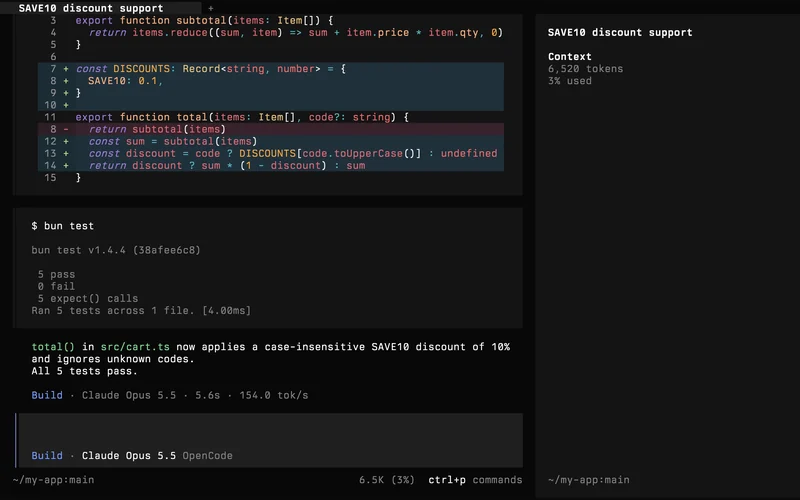
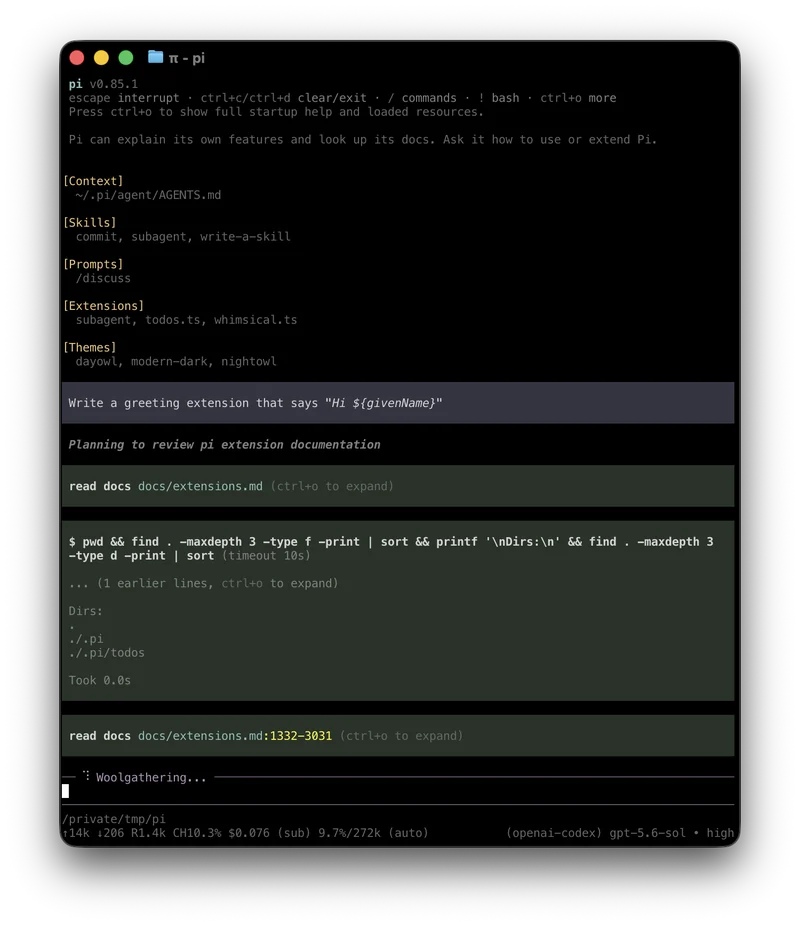
What it is
Terminal agent for writing, reviewing and running code in local projects
LaBunbun Code is an AI-driven terminal coding agent that supports access to a range of models, including ChatGPT, Claude, DeepSeek, Kimi, and GLM.
Coding agent with switchable build and read-only plan agents
Minimal, extensible agent harness that you can make your own
Category
CLI agent
CLI agent
CLI agent
CLI agent
Pricing
Starts at (billing shown)
Not yet verified
Not yet verified
Not yet verified
Not yet verified
Lowest monthly plan
Not yet verified
Not yet verified
Not yet verified
Not yet verified
Free tier
Not yet verified
Not yet verified
Plans
- Open-source softwareFree
Not yet verified
Not yet verified
- Open-source softwareFree
Bring your own key
Yes
Not yet verified
Yes
Yes
Runs on
Linux
Not yet verified
Yes
Not yet verified
Yes
Terminal
Not yet verified
Yes
Yes
Yes
Web
Not yet verified
Not yet verified
Yes
Not yet verified
Windows
Not yet verified
Yes
Yes
Yes
macOS
Not yet verified
Yes
Not yet verified
Yes
Models and agents
Model providers
Not yet verified
Models
Not yet verified
Not yet verified
Drives these agents
Not yet verified
Not yet verified
Not yet verified
Not yet verified
Source and activity
Source
GitHub stars
Most
Release days, last 90 days
19
0
28Most
19
Release days per week
Latest release, any channel
v0.23.2+canary.20261118T064620Z 18 Nov 2026
v0.1.0.5-alpha.1 16 Nov 2026
v2.3.2 18 Nov 2026
v1.5.2 10 Nov 2026
Index score
Score and rank
48 #14 Score 48.2; ranked on the unrounded score
Not enough data yet
79 #3 Score 78.8; ranked on the unrounded score
78 #4 Score 77.9; ranked on the unrounded score
Mindshare
4884 Hacker News mentions in the last 90 days
00 Hacker News mentions in the last 90 days
791,414 Hacker News mentions in the last 90 days
781,310 Hacker News mentions in the last 90 days
Adoption, not scored
100264,230 stars, read 18 Nov 2026
188 stars, read 18 Nov 2026
100227,631 stars, read 18 Nov 2026
96122,575 stars, read 18 Nov 2026
Votes
—Votes can only raise a score: up to 20% of it reflects upvotes, graded on a curve against the most-voted tool. The square-root curve has a floor of 100 effective votes. Votes decay with a 90-day half-life. Maker self-votes do not count. Counts below 10 are hidden for display only.
—Votes can only raise a score: up to 20% of it reflects upvotes, graded on a curve against the most-voted tool. The square-root curve has a floor of 100 effective votes. Votes decay with a 90-day half-life. Maker self-votes do not count. Counts below 10 are hidden for display only.
—Votes can only raise a score: up to 20% of it reflects upvotes, graded on a curve against the most-voted tool. The square-root curve has a floor of 100 effective votes. Votes decay with a 90-day half-life. Maker self-votes do not count. Counts below 10 are hidden for display only.
—Votes can only raise a score: up to 20% of it reflects upvotes, graded on a curve against the most-voted tool. The square-root curve has a floor of 100 effective votes. Votes decay with a 90-day half-life. Maker self-votes do not count. Counts below 10 are hidden for display only.
Rank history
First ranked 18 Nov 2026
Not ranked
First ranked 18 Nov 2026
First ranked 18 Nov 2026
Full page
Watch Hermes Agent vs labunbun-code vs OpenCode vs Pi on YouTube
More comparisons
Build your own

Claude Code CLI vs Codex CLICLI agents


Cursor editor vs Devin DesktopEditors


Conductor vs cmuxAgent workspaces

Conductor vs T3 CodeAgent workspaces

T3 Code vs ParadevAgent workspaces

Claude Code CLI vs Codex CLI vs Gemini CLICLI agents

Cursor editor vs Devin Desktop vs ZedEditors



Cline vs Kilo Code vs ContinueIDE extensions



Devin vs Jules vs OpenHandsCloud agents



Lovable vs Bolt.new vs v0App builders
cmux vs Conductor vs Claude SquadAgent workspaces