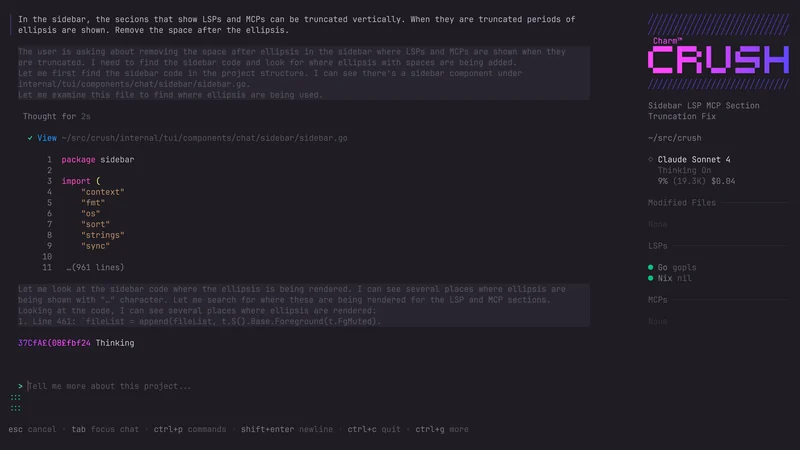
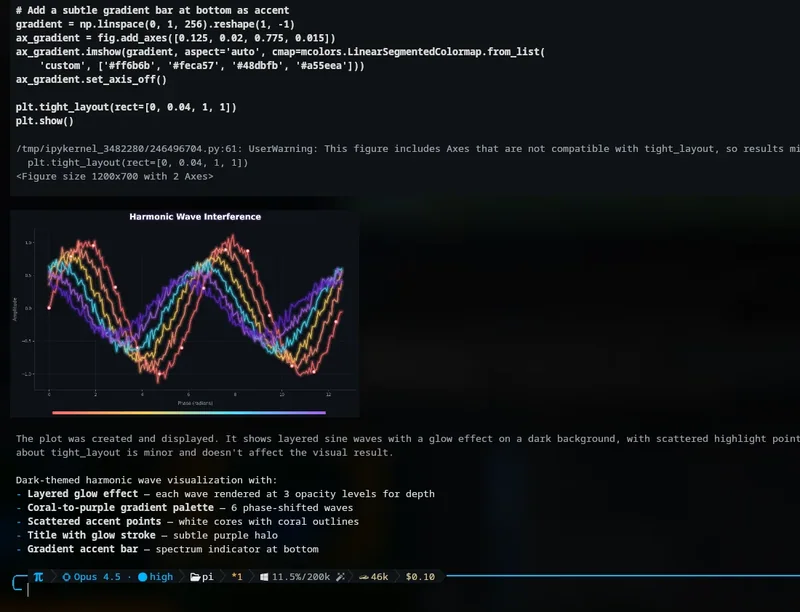
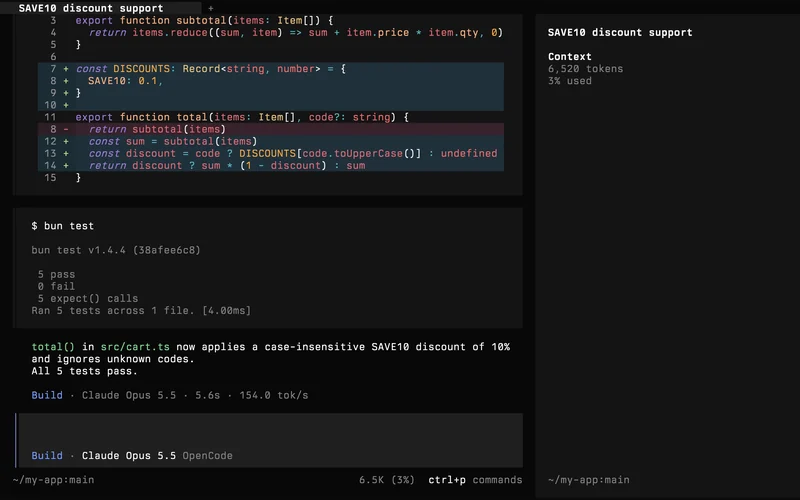
oh-my-pi is a fork of Pi: omp is a fork of Pi by Mario Zechner, rewritten as a coding-first surface: sessions, subagents, slash commands, extensions — all TypeScript, all MIT, all on GitHub.raw.githubusercontent.com
SystemsCrush 2 · oh-my-pi 4 · OpenCode 2 · 1 in all
Crush
oh-my-pi,,
OpenCode
Show 1 shared
Pick this if…
OpenCode
Paraphrased from each maker’s own description. Select a line for the quote.
Checked for oh-my-pi and OpenCode, not yet for Crush: Price (oh-my-pi: ; OpenCode: )
Not yet checked for any of these tools: agents it runs.
Dotted values open their quote.
What each can do
Select an answer to see the maker’s sentence, or what we searched.
We have not checked Crush’s capabilities yet. 22 capabilities are checked for at least two of these tools. 4 differ only in a limit. 10 others are checked for one tool only.
Editors, scripts and CI Editor integration, Headless mode, JSON output, GitHub integration, Commit attribution control
Review, steer and undo Plan mode, Read-only mode, Review diffs, Undo file edits
Parallel agents Parallel sessions, Git worktrees
Context and memory Project instruction files, Memory across sessions, Resume a session, Browse past sessions
Remote and mobile control Remote control, Steer from a phone, Notifications
Sandbox, permissions and privacy OS-level sandbox, Approval modes, Runs in a container, Telemetry opt-out
Images, web and your computer Image input, Web search, Fetch URLs, Browser automation, Computer use, Voice input
We have not checked these yet. They may or may not be supported.
,
10 capabilities not yet checked for oh-my-pi
Models, keys and usage Token and cost usage
Editors, scripts and CI Commit attribution control
Review, steer and undo Undo file edits
Parallel agents Parallel sessions
Remote and mobile control Steer from a phone, Notifications
Sandbox, permissions and privacy OS-level sandbox, Runs in a container, Telemetry opt-out
Images, web and your computer Voice input
We have not checked these yet. They may or may not be supported.
,
10 capabilities not yet checked for OpenCode
Editors, scripts and CI GitHub integration, Commit attribution control
Context and memory Memory across sessions
Remote and mobile control Remote control, Steer from a phone
Sandbox, permissions and privacy OS-level sandbox, Telemetry opt-out
Images, web and your computer Browser automation, Computer use, Voice input
We have not checked these yet. They may or may not be supported.
5 capabilities are not yet checked for any of these tools and are not shown. Each answer is about the CLI agent in its column. Something the maker publishes separately, such as an editor plugin or a GitHub Action, shows as “With add-on”, even when it has its own listing here. How capabilities are checked
Votes can only raise a score: up to 20% of it reflects upvotes, graded on a curve against the most-voted tool. The square-root curve has a floor of 100 effective votes. Votes decay with a 90-day half-life. Maker self-votes do not count. Counts below 10 are hidden for display only. After activation, the score is 80% mindshare plus 20% of the greater of mindshare and the vote score. GitHub stars do not affect the Index score. Mindshare uses a log scale; votes use the square-root curve and a 100-vote floor. Ranks use unrounded scores. Mindshare and adoption bars are log-scaled; the others are linear within this comparison. How the score is built
—Votes can only raise a score: up to 20% of it reflects upvotes, graded on a curve against the most-voted tool. The square-root curve has a floor of 100 effective votes. Votes decay with a 90-day half-life. Maker self-votes do not count. Counts below 10 are hidden for display only.
—Votes can only raise a score: up to 20% of it reflects upvotes, graded on a curve against the most-voted tool. The square-root curve has a floor of 100 effective votes. Votes decay with a 90-day half-life. Maker self-votes do not count. Counts below 10 are hidden for display only.
—Votes can only raise a score: up to 20% of it reflects upvotes, graded on a curve against the most-voted tool. The square-root curve has a floor of 100 effective votes. Votes decay with a 90-day half-life. Maker self-votes do not count. Counts below 10 are hidden for display only.