cmux vs Ragon vs T3 Code vs Warp
Up to four tools, row by row. We do not guess: a cell we have not checked says so.
How they differ
Pick this if…
Paraphrased from each maker’s own description. Select a line for the quote.
Capabilities not yet checked for all
- · also Warp
- · also T3 Code and Warp
- · also T3 Code
- · also Warp
- · also cmux and Warp
- · also Warp
- · also cmux
- · also cmux
- · also T3 Code
- · also cmux and T3 Code
- · also T3 Code
Checked for cmux, T3 Code and Warp, not yet for Ragon: Price (cmux: ; T3 Code: ; Warp: )
Checked for Warp, not yet for cmux, Ragon and T3 Code: Model providers (, , , )
Checked for cmux and Warp, not yet for Ragon and T3 Code: Bring your own key (cmux: ; Warp: )
Checked for cmux and T3 Code, not yet for Ragon and Warp: Agents it runs (cmux: , , , , , ; T3 Code: , , , , , ), Editors and systems (cmux: , , ; T3 Code: , , )
Provider names use the same listing as each tool page. Dotted values open their quote. A capability not shown is not yet checked; the tool may still have it.
About these tools
Ragon
T3 Code
Warp
At a glance
Index score out of 100
cmux42RagonNot enough data yetT3 Code48Warp34
Mindshare HN mentions, 90 days
cmux46Ragon0T3 Code79Warp22
Adoption GitHub stars, not scored
cmux28.8kRagonNot yet checkedT3 Code64.2kWarp66k
Release days last 90 days
cmux7Ragon6T3 Code20Warp0
Lowest monthly plan billed monthly, lower is cheaper
cmux$50/moRagonNot yet checkedT3 CodeNot yet checkedWarp$20/mo
Platforms listed surfaces
cmux3Ragon2T3 Code6Warp2
Readers who say they use it
Already use any of these? Tick it. Several is fine.
Votes can only raise a score: up to 20% of it reflects votes, graded on a curve against the most-voted tool. The square-root curve has a floor of 100 effective votes. Votes decay with a 90-day half-life. Maker self-votes do not count. Counts below 10 are hidden for display only. A vote is a signed-in reader ticking “I use this”. Since votes joined the score on 18 Nov 2026, the score is 80% mindshare plus 20% of the greater of mindshare and the vote score. GitHub stars do not affect the Index score. Mindshare uses a log scale; votes use the square-root curve and a 100-vote floor. Ranks use unrounded scores. Mindshare and adoption bars are log-scaled; the others are linear within this comparison. How the score is built
Differences only



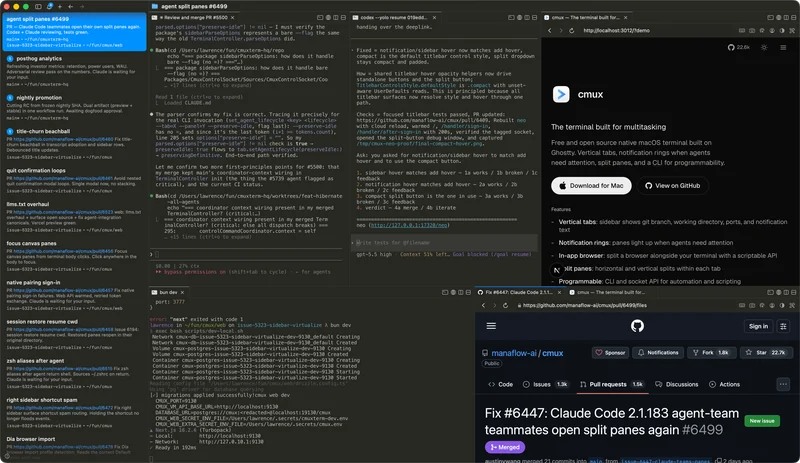
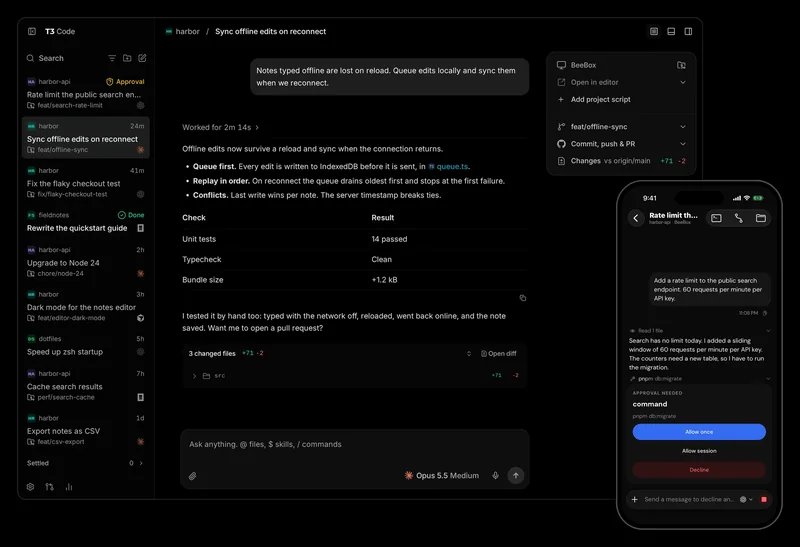
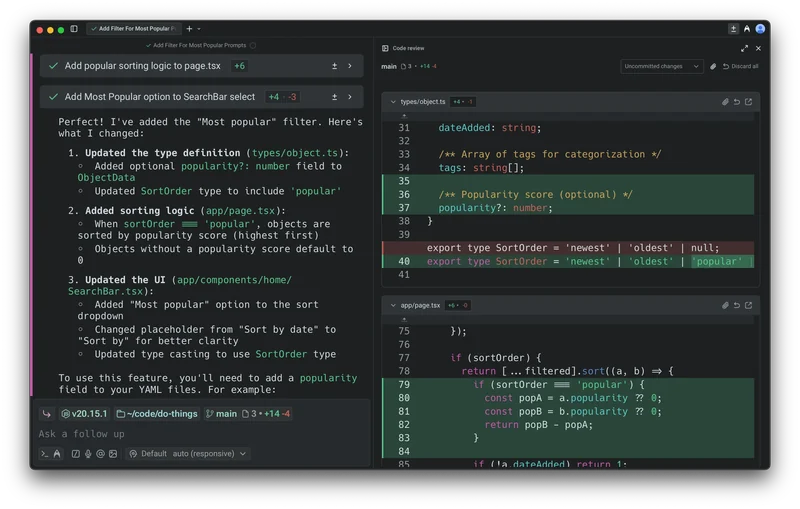
4 of 4
cmuxmanaflow-ai · Desktop app
RagonDesktop app
T3 CodePing.gg · Desktop app
Warpwarpdotdev · Desktop app
Interface
What it is
Native macOS terminal with agent notifications, split panes and a CLI
Local coding agent and desktop interface for NVIDIA GB10 machines
Desktop and web interface for coding agents, with phone approvals
Terminal with coding agents and cloud automation
Category
Agent workspace
Agent workspace
Agent workspace
Agent workspace
What it does
Form
Desktop app
Desktop app
Desktop app
Desktop app
Parallel agents
Yes
Not established
Not established
Yes
Worktree isolation
Not established
Not established
Yes
Yes
Task board
Not established
Not established
Not established
Not established
Agent teams
Yes
Not established
Yes
Yes
Review & diffs
Not established
Not established
Yes
Yes
Remote session control
Yes · beta · paid tier only
Not established
Yes
Not established
Team collaboration
Not established
Not established
Not established
Not established
Agent & model switching
Not established
Not established
Yes
Not established
Pricing
Starts at (billing shown)
Not yet checked
Lowest monthly plan
Not yet checked
Not yet checked
$20/moLowest monthly
Free tier
Not yet checked
Plans
- Free$0/mo
- Pro$50/mo
- Pro (yearly)$40/mo billed yearly
- Team$60/user/mo
- Max$200/mo
- Max (yearly)$160/mo billed yearly
- EnterpriseCustom
Not yet checked
- Open-source softwareFree (open source)
- FreeFree
- Build$20/mo
- Business$50/user/mo
- Max$200/mo
- EnterpriseNot yet checked
Bring your own key
Yes
Not yet checked
Not yet checked
Yes
Runs on
Android app
Not yet checked
Not yet checked
Yes
Not yet checked
Linux
Not yet checked
Not yet checked
Yes
Not yet checked
Phone (web)
Not yet checked
Yes
Not yet checked
Not yet checked
Terminal
Yes
Not yet checked
Not yet checked
Yes
Web
Not yet checked
Yes
Yes
Yes
Windows
Not yet checked
Not yet checked
Yes
Not yet checked
iOS app
Yes
Not yet checked
Yes
Not yet checked
macOS
Yes
Not yet checked
Yes
Not yet checked
Models and agents
Model providers
Not yet checked
Not yet checked
Not yet checked
Models
Not yet checked
Not yet checked
Not yet checked
Drives these agents
Not yet checked
Not yet checked
Source and activity
Source
GitHub stars
Not yet checked
Most
Release days, last 90 days
7
6
20Most
0
Release days per week
Latest release, any channel
v0.65.2.2 27 Oct 2026
v0.9.7 17 Nov 2026
v0.1.11-nightly.20261118.4890 18 Nov 2026
v0.2026.06.09.19.54.dev_00 9 Jun 2026
Index score
Score and rank
42 #23 Score 41.8; ranked on the unrounded score
Not enough data yet
48 #15 Score 47.6; ranked on the unrounded score
34 #32 Score 34.0; ranked on the unrounded score
Mindshare
4246 Hacker News mentions in the last 90 days
00 Hacker News mentions in the last 90 days
4879 Hacker News mentions in the last 90 days
3422 Hacker News mentions in the last 90 days
Adoption, not scored
8428,813 stars, read 18 Nov 2026
Not yet checked
9164,241 stars, read 18 Nov 2026
9166,043 stars, read 18 Nov 2026
Rank history
First ranked 18 Nov 2026
Not ranked
First ranked 18 Nov 2026
First ranked 18 Nov 2026
Full page
Watch cmux vs Ragon vs T3 Code vs Warp on YouTube
More comparisons
Build your own

Claude Code CLI vs Codex CLICLI agents


Cursor editor vs Devin Desktop (formerly Windsurf)Editors

Conductor vs cmuxAgent workspaces
Conductor vs T3 CodeAgent workspaces

T3 Code vs ParadevAgent workspaces

Claude Code CLI vs Codex CLI vs Gemini CLICLI agents

Cursor editor vs Devin Desktop (formerly Windsurf) vs ZedEditors



Cline vs Kilo Code vs ContinueIDE extensions


Devin vs OpenHandsCloud agents



Lovable vs Bolt.new vs v0App builders

cmux vs Conductor vs Claude SquadAgent workspaces