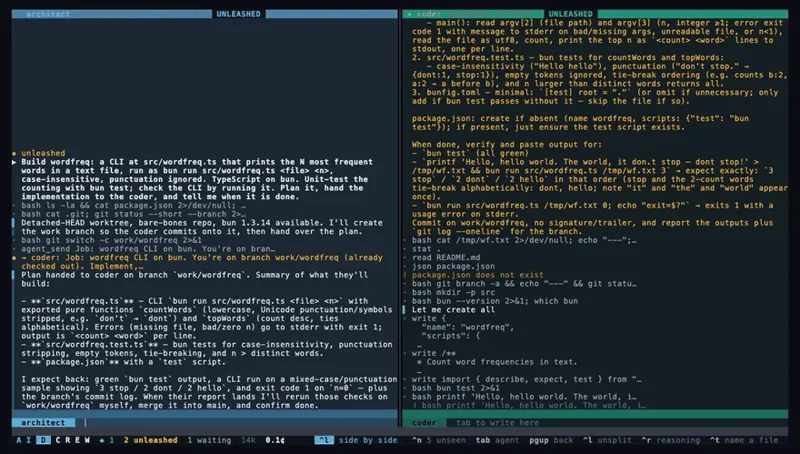
aidcrew
Terminal coding-agent teams with per-job worktrees and separate model choices · Source
Up to four tools, row by row. We do not guess: a cell we have not verified says so.
Sourced for aidcrew and OpenRig, not yet for tsk-tsk: Price (aidcrew: ; OpenRig: ), Editors and systems (aidcrew: ; OpenRig: , , )
Sourced for aidcrew, not yet for OpenRig and tsk-tsk: Model providers (, , , , ), Bring your own key ()
Sourced for OpenRig, not yet for aidcrew and tsk-tsk: Agents it runs (, )
Dotted values open their quote. A capability not shown is not yet sourced; the tool may still have it.
Terminal coding-agent teams with per-job worktrees and separate model choices · Source
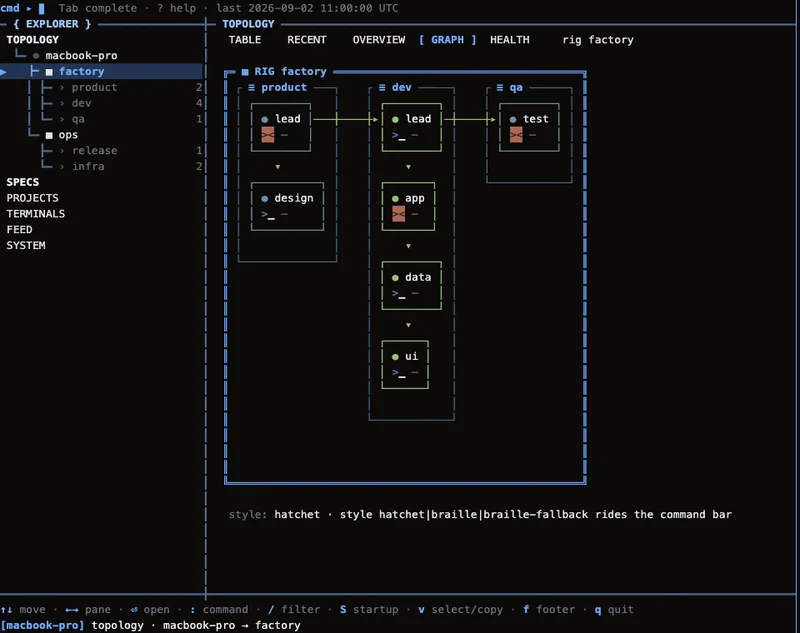
Build your own network of agents from Claude Code, Codex and Pi: persistent teams with roles, shared context and owned work. · Source
Build your own network of agents from Claude Code, Codex and Pi: persistent teams with roles, shared context and owned work.
Keeping your agents out of trouble with sandboxed coding agent automation · Source
Votes can only raise a score: up to 20% of it reflects upvotes, graded on a curve against the most-voted tool. The square-root curve has a floor of 100 effective votes. Votes decay with a 90-day half-life. Maker self-votes do not count. Counts below 10 are hidden for display only. After activation, the score is 80% mindshare plus 20% of the greater of mindshare and the vote score. GitHub stars do not affect the Index score. Mindshare uses a log scale; votes use the square-root curve and a 100-vote floor. Ranks use unrounded scores. Mindshare and adoption bars are log-scaled; the others are linear within this comparison. How the score is built

Watch aidcrew vs OpenRig vs tsk-tsk on YouTube